
A year without books is like a year without spring. —me, myself, and I.
We’re more than halfway through a year that has brought with it some amazing reads. Can you tell I’m focusing on the positive? Yes, I know 2026 has resulted in a highly volatile war (what is it good for?) and other harrowing issues, including a compounding economic crisis. But I have managed to find a silver lining in new books that have felt like rare gems. You’ll be happy to hear AI agrees with me. And I quote: “The literary landscape has been absolutely packed with stellar releases recently. From breathtaking literary fiction to pulse-pounding thrillers, the momentum has been unreal.” High-five, AI! I couldn’t agree more; in fact, that seems like anything but artificial to me.
It should not surprise anyone who reads our reviews with regularity that we L-O-V-E Maggie O’Farrell. She is very, very extraordinary. We love her more than anyone she adores can love. And why wouldn’t we? We’re English majors after all, and this woman is celebrated, rightfully so, as one of the greatest contemporary storytellers. Last month, my sister and I flew home together from Connecticut. She asked if she should watch Hamnet, not knowing anything about the storyline. “Absolutely” was my response. Tears filled her eyes at one point—that’s when she said, “This is killing me.” From the seat next to her, looking over her shoulder, I had to hold back my own tears. Mags doesn’t shy away from heartache, trauma, or grief. Instead, the inspired writer provides unique insights. She offers us emotional and literary depth but manages to harness pace and capture mystery. Very few authors can check all those boxes. I swear, she makes it look easy.
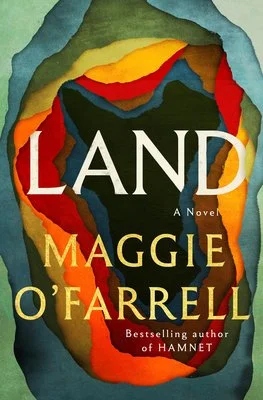
Mags is a brilliant historical novelist. Her latest setting revolves around an Gorta Mor, meaning the Great Hunger—a period of mass starvation and disease in Ireland from 1845 to 1852, triggered by a potato blight that destroyed successive crop yields. (It’s sobering to admit I had no idea that roughly a million people died because of the Great Famine.) Land was inspired by O’Farrell’s great-great-grandfather, who was an Irish mapmaker, and so the story follows a mapmaker and his family whom the British hire to survey the land. What they and none of us can really know is how much the land holds—generational stories (many of them sad), secrets, history, even mystical stuff. If you’re a Maggie O’Farrell fan, you’ll enjoy this exploration of “memory, loss, and the art of witnessing.” Since I am a big fan, I can say way to add to the breathtaking literary landscape in 2026!