Follow-Up Friday

“Either you follow-up, or you fold-up.” – Bernard Kelvin Cline

TGIF, my friends. Although the days of 2020 seem to blend together, Fridays still tend to be extra sweet. It’s an extra special Friday to chat lit, as we’re moving into the cozy days of fall—hope you have a chance to nestle under a blanket with your favorite drink and current read this weekend!

We’ve shared posts about books that now have sequels, so of course, we had to read them. Be warned: it’s rare to find a sequel that’s better than the original, but the books below are worth your time. If you haven’t read the original books, we suggest putting a pin in this post until you’ve dived into the originals.

P.S. There are multiple spoilers in the review below!
“If I’m going to have regrets in this life, I’d rather them be for the chances I took and not the opportunities I let slip away.”

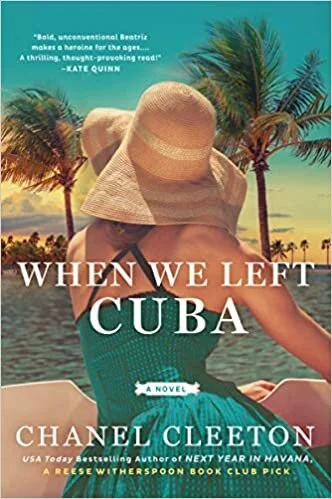
 If this post rang true to you, get excited: Chanel Cleeton’s sequel When We Left Cuba tells the story of Beatriz, the life of the party in the Perez family. SPOILER ALERT: Following their exile from Cuba, Beatriz focuses her efforts to going back. Her goal: avenge her brother’s death and kill Fidel Castro, while working with the CIA. Adding a layer of complexity, Beatriz falls in love in with a powerful politician and begins a secret (and forbidden) relationship. Trying to balance her secret missions and passions proves difficult. Beatriz is left with no choice but to sacrifice one to gain the other.

This book deserves a solid 3.7 out of 5 stars. Most sequels have a hard time packing the same punch that originals do. You gotta give Cleeton credit though, it’s hard to come off a home run of a first release (just ask MC Hammer). While the story of Next Year in Havana is more captivating, you’ll be turning pages to find out what crazy thing Beatriz does next.
“When you get old, you become invisible. It’s just the truth. And yet it’s freeing in a way…You go through life and you think you are something. Not in a good way, and not in a bad way. But you think you are something, and then you see that you are no longer anything. To a waitress with a huge hind end you’ve become invisible. And it’s freeing.”

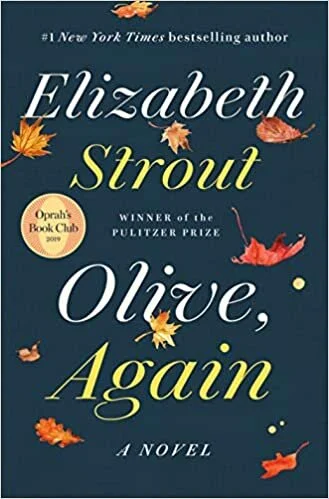
Glowing praise from Tracy for Olive Kitteridge motivated my mom and me to get to know the impossibly flawed Mainer. The prize winner one of the best-written books we’ve read all year, so the natural next step was to read her second story, Olive, Again. Elizabeth Strout picks up her story where she left off – we’re taken directly into the mind of Olive, as she provides the blunt reasoning produced by her later years. Not only is she attempting to mend the relationship with her son and daughter-in-law, she’s trying to navigate (and squander) her feelings for Jack Kennison. Thirteen additional stories from the townspeople of Crosby tie together 10 more years of Olive’s life. Jump into the story to join the pursuit of Olive’s quest to find what makes her “not unhappy.”

While the original book had better stories and more thought-provoking mind rants, Strout poses deep life questions that one ponders towards the end of their lives. The sequel deserves  4 out of 5 stars and a few hours of your time.

PS- if you’re into TV, HBO made the first book into a mini-series!
Posted by Michelle

2020 Reading List

The only effect I ardently long to produce by my writings, is that those who read them should be better able to imagine and to feel the pains and the joys of those who differ from them in everything but the broad fact of being struggling, erring human creatures. —George Eliot

Last week was rough, dear reader. And that’s saying something in the midst of a very rough year. Is 2020 over yet? This year has been heavy on shouting and light on listening. Cue last night’s debate. Things are at a fever pitch and I’ve got the family email, laced in all-caps and chock-fulla venom, to prove it. While it made me ache for a gentle brother gone too soon and a father who wore his compassion in his eyes, I didn’t take the personal attack personally. I recognized it as just another symptom of a far greater problem: an alarming lack of tolerance and empathy.

I’m not a hopeless person, but lately those silver-linings I’m good at spotting are proving harder to find. 2020 seems to be the perfect storm. Quarantine led to isolation which led to more people spending more time on social media. Which is rarely, if ever, a good thing. Don’t believe me? Watch The Social Dilemma on Netflix and then we’ll chat. That got me thinking: could the answer be as simple as getting everyone to read more? Not more editorials or conspiracy theories. Not more books selling an agenda or the latest tell-all. I’m talking stories here. The kind that let us see the world from another’s point of view by climbing in their skin and walking around a while. When in doubt, channel Atticus.

Here’s a roundup of recent reads that have helped me tune out the noise from both sides and focus on what really matters: people and their stories. Please know this isn’t a list of books to persuade readers to one side or the other of the political spectrum, it’s simply a hope of putting human faces to the issues that polarize us. In the words of Brené Brown, “people are hard to hate close up.”

Racism

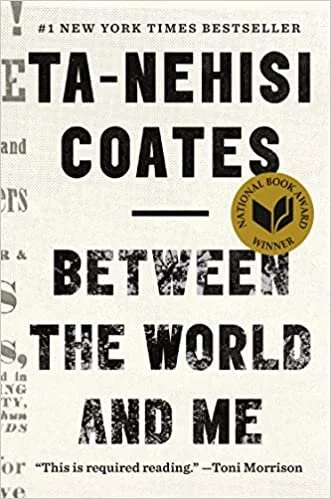
I lost sleep over this book. And still, if I wake in the night and think of it, my heart breaks all over again and sleep eludes me as I lie there thinking of the children navigating the unforgiving streets of their neighborhood, who don't know what it's like to grow up not fearing for their lives. I hear this line from Coates and weep for the mothers and grandmothers every time: “Black people love their children with a kind of obsession. You are all we have, and you come to us endangered.” If you're ever inclined to say we don't have a racism problem in America, please read this book first.

Immigration

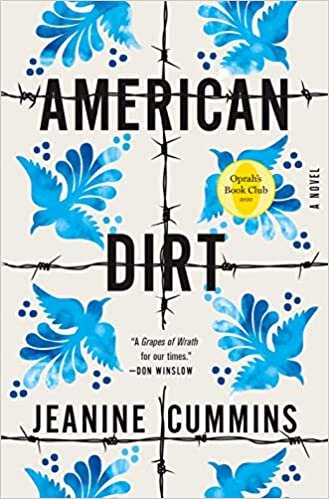
Tray reviewed this important read back in April and asked me to weigh in on the controversy surrounding it. So 5 months later (which is par for the course these days), I’ll say this: From what I’ve read of the controversy, the main complaint was the author, not being hispanic herself, Americanized her characters too much in order to make them more relatable to her readers. I’m in no position to argue that point, but I will say that when a book is able to humanize the plight of a people caught in the political crossfires, it’s well worth the read. American Dirt not only does just that, it does it beautifully. For more, read Tray’s review here.

One thing that should bring solace to those who decried Cummins’s merits in speaking to their experiences: her book led me to search out more on the subject. I recently listened to “The Out Crowd,” the Pulitzer-Winning audio broadcast from This American Life. It’s the first audio broadcast to win the Pulitzer and, like Between the World and Me, it’s kept me up at night. Everyone needs to hear this—regardless of your opinions on immigration. You can find the broadcast here. I also just started Once I was You: A Memoir of Love and Hate in a Torn America by Maria Hinjosa. I’ll keep you posted!

A Forgotten People

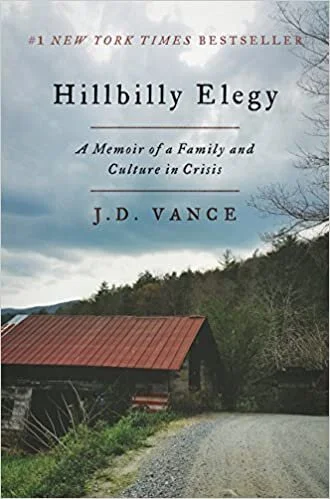
I read this book in an attempt to deconstruct the 2016 election and the role played by working-class whites in electing Trump. It ended up being my favorite and most important read of 2017. I wrote then: Vance offers an unflinching look at his family and a culture in crisis and "what a social, regional, and class decline feels like when you were born with it hung around your neck." Because it's told from the inside, it never feels patronizing or heavy-handed. As Vance reminds us, "there are no villains in this story. There’s just a ragtag band of hillbillies struggling to find their way—both for their sake and, by the grace of God, for mine.” Read the rest of my review here.

This book inspired me to recently pick up Tightrope: Americans Reaching for Hope. That, and this review by the author of Educated, Tara Westover: “A deft and uniquely credible exploration of rural America, and other left-behind pockets of our country. One of the most important books I’ve read on the state of our disunion.”

Racial Injustice

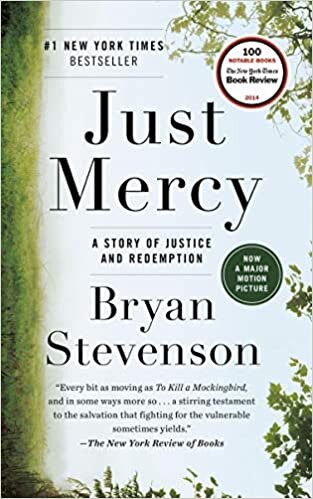
I can’t recommend this book loudly enough. Don’t be fooled into thinking if you’ve seen the movie, there’s no need to read the book. First of all, is that ever true? I would submit no but in the case of this book, it’s a resounding no. The movie only scratches the surface of Bryan Stevenson’s amazing work. He’s the real-life Atticus. No joke. Here’s a snippet from my earlier review: A good non-fiction is hard to find. Even harder? One that permeates our sheltered lives and upends our worldview. If there was a required reading list for life, Just Mercy would be on it. Stevenson shines an unadulterated light on the destructive effects of mass incarceration, a broken judicial system, and the devastating consequences when we reduce the worth of a human soul to "the worst thing [they've] ever done." This book feels like a clarion call—one that pleads, as Maya Angelou once said, "when you know better, do better."

You can read the rest of my review here.

Slavery and the Destruction of the Black American Family

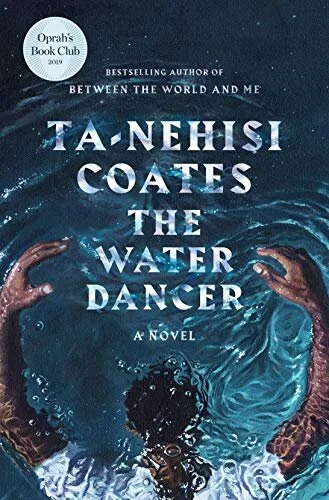
Perhaps one of the most far-reaching tragedies of slavery is the calculated decimation of the black American family by slave owners. Those consequences run deep and last for generations. This is clearly something that haunts Coates as evidenced by his original work: Between the World and Me. A heart-wrenchingly beautiful tale of an illegitimate son of a slave owner who is forced to watch his mother, the man who loved her, and all his siblings sold off one by one to places unknown. Never to be seen or heard of again. Let that sink in. No family history. No stories passed down through the generations other than one of deep longing and sorrow for what might have been.

“I felt a great rage, not simply because I knew they had been taken but because I knew how they had been taken, how they had been parted from each other, how I was born and made by this great parting. Better than before, I understood the whole dimensions of this crime, the entirety of the theft, the small moments, the tenderness, the quarrels and corrections, all stolen, so that men such as my father might live as gods.”

Posted by Rachel

Candle in the Wind

“Reading is the key that opens doors to many good things in life. Reading shaped my dreams, and more reading helped me make my dreams come true.” —Ruth Bader Ginsberg

“Life is a brief candle, but love is a craving for time.”


Rest in peace Ruth. Thank you for being your own person—for being a leader and a true visionary. We need strong women with strong values more now than ever before. Of course, I’m particularly fond of any rockstar dynamo who will acknowledge the power of reading to help open doors and lasso dreams. I wonder if the notorious, glorious RGB picked up a copy of The Confessions of Frannie Langton in the past year? 

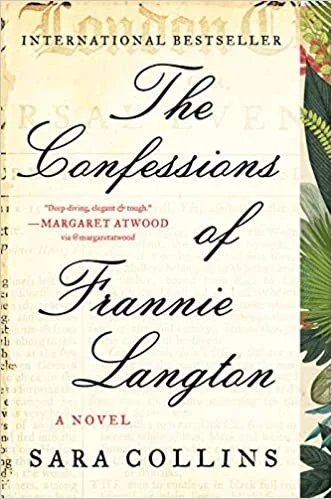
Something tells me the Supreme Court Justice would thoroughly appreciate Frannie Langton, a Jamaican slave who “travel[ed] across the Atlantic and through the darkest channels of history.” Literacy bought her thoroughfare. (She was part of a “little colonial experiment” by a depraved scientist in Jamaica, which afforded her an education, despite being enslaved.) Swapped from an “iron cage for a gilded one,” Frannie was gifted to George Benham, a scientist who was purported to be the finest mind in England. Benham’s French wife, Marguerite, forms an unlikely “special” relationship with Frannie. She shattered the Jamaican girl’s belief that every white you’ll ever meet “either wants to tame you or rescue you.” So how do both of the Benhams wind up being murdered at the hands of this mulatta slave? Is she responsible for their untimely deaths?  You’re gonna have to read to find out. It’s true: “The Confessions of Frannie Langton is large, lavish and gutsy, a skilled and intoxicating mash-up of slave narrative, gothic romance, whodunit and legal thriller.” 

P.S. I did some supplemental reading about Sarah Collin’s debut novel. This was pretty insightful: “Frannie is an extreme version of Jane Eyre. She is a powerless child brought up horribly in a horrible place, and her voice thunders in exactly the same way. She often says things that are true, but jarring, such as: “A man writes to separate himself from the common history; a woman writes to try to join it.” Her pronouncements are just like those of Jane, who isn’t afraid to tell Rochester that she loves Thornfield in part at least because she has not “been buried under inferior minds.” Like Jane again, Frannie is awkward and pretentious in her cleverness because she has never been allowed to exercise it properly. Rochester calls Jane a caged bird, but Frannie is a battery hen.” If you love Jane, you’re gonna like Frannie.

Posted by Tracy

The Bees Knees

“Mother Nature knit a careful plan in place, and if you pulled one thread of it loose, the whole thing could unravel. These insects that made most people run in fear were the invisible glue of the earth that held us all together.”

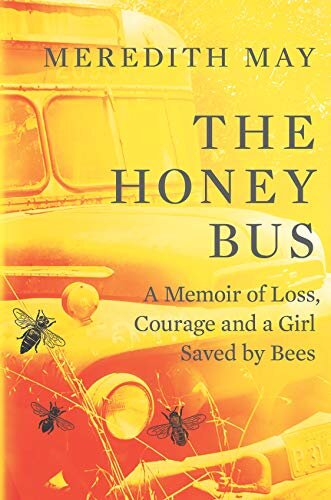
Did someone say sizzling pace or was it fizzling pace? I’ll let you guys decide. I’m a wee bit upset with myself for waiting so long to write about one of my favorite reads of a somewhat miserable 2020. (Not to worry—the glass is still half full, I promise.) Maybe it was subconscious? After all, I had to distribute The Honey Bus by Meredith May to the masses before I let the cat out of the book bag. It’s hard to beat a never-before-heard-of memoir in the mailbox that wraps you up, pulls you in, and penetrates your unsuspecting heart. Don’t believe me? Give me your address.

If you liked The Glass Castle and Educated, you’ll love The Honey Bus. This novel reminded me that we can mend our broken parts if we’re astute enough to see the world through new eyes when life destroys the lens we’ve formerly looked through. May’s childhood lens shatters when her parents get divorced. When her mother hits the proverbial (and dysfunctional) rock bottom, May’s kindhearted grandfather introduces her to the productive world of bees who teach her important lessons about family. Survival too. Already, I want to read it again. I’m 100% with the reviewer who observed that this memoir is “filled with grace, beauty and wisdom, [it’s] like warm honey in the sunshine.” You’ll definitely want to bask in this one.

Posted by Tracy

Good, Better, Best

How are the longer, lighter days of summer winding down already? We’re not remotely ready to slow the reading flow just yet. Maybe Corona will help us keep our sizzling pace? (Come on, two posts a week constitutes some sizzle, doesn’t it?) Here’s a good, better, best post for those of you who are trying to read by the fading natural light.

Good

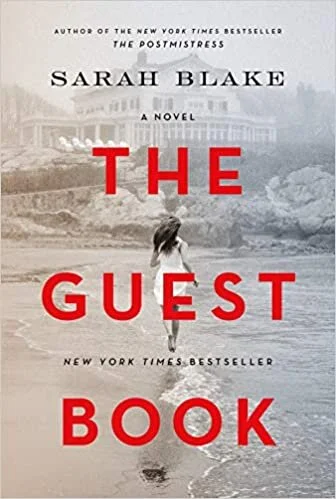
Coming from a family of pleasers, The Guest Book reminds me that sometimes saying “no” is not necessarily the best answer. The rich and powerful Milton family, hailing from New York, has secrets that neither propriety nor time can dismantle. When decades of family deceit surface on their island in Maine, descendants begin to question their lily-white legacy. This read offers up intrigue, some good ole fashioned elitism with a splash of racism. It underscores the idea that things aren’t always as they appear. So find yourself an island and pick up this 4-star beach read.

Better

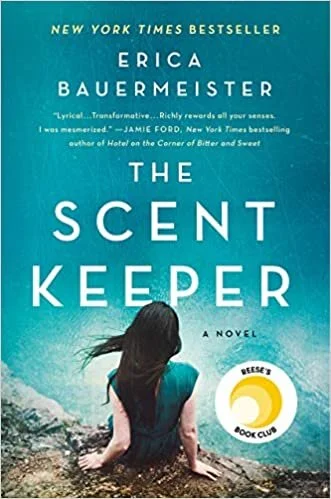
Speaking of island reads, The Scent Keeper gave me all the beach feels. If forced to choose between the two, I’d definitely pick Bauermeister’s coming-of-age novel. I’m 100% with Macmillan Publishers about this Reese Book Club pick: “Lyrical and immersive. The Scent Keeper explores the provocative beauty of scent, the way it can reveal hidden truths, lead us to the person we seek, and even help us find our way back home.” You’re bound to love Emmaline’s fragrant search for her place in the world.

Best

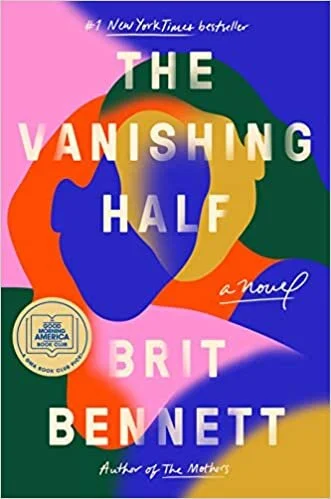
The Vanishing Half earned the highest honors because this recent release has it all: plot twists, family dynamics, passing, racial identities, and (like Rachel) identical twins. One twin sister is trapped in an abusive marriage, only to run back to her rural Louisiana hometown. The other sister tries to escape racism by passing and marrying a prominent white man. Non-parallel paths reveal the stark difference between a black and white world. I’m not the only one singing Bennett’s praises—Kiley Reid, author of Such A Fun Age, had this to say: “Bennett’s tone and style recalls James Baldwin and Jaqueline Woodson, but it’s especially reminiscent of Toni Morrison’s 1970 debut novel, The Bluest Eye.”

Guest Post by Sharee

Victorian Lives Matter

“Whatever our souls are made of, his and mine are the same.”

Eliane,

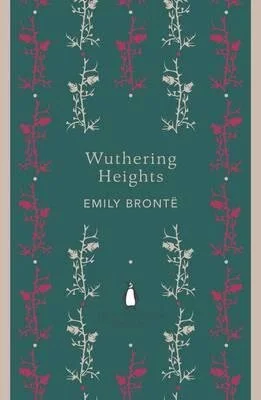
I’m sorry you’re sad, my friend. There’s no question Hindley had it rough and, like Michael Jackson, was gone too soon. If we want to dwell in bleakness momentarily, Hindley got quite a few more years than Linton, who died at the unripe age of 17. Catherine and Frances gave up the ghost at 18. (Well Frances did anyway.) By these standards, Isabella, captured longevity; she lived until she was 31. This is a classic case of literature mirroring real life. Tragically, Emily Bronte died at age 30, Anne at 29, and Charlotte didn’t make it to her 39th birthday—tuberculosis robbed each of them of so many years. (Imagine the classics that were buried alongside those sisters. Big Heavy Sigh.)

Why do I feel compelled to ask if it’s important to read sad stories? What do we learn from the sobering stuff? Awareness is the first answer that comes to mind. (Victorian Lives Matter.) I’m especially passionate about gender ideology, I know you are too—we need to understand unjust cultural requirements and unfair expectations for women. We need to learn from the past in order to move forward and stay forward. In the light. Empathy is another important answer to the question why should we read sobering stories? Walk a mile in another girl’s shoes, right? I felt for young Catherine. What a horrible web she got caught in. And I wanted to cry out a warning sound to insecure Isabella.

But as usual, I’ve meandered from the pressing question that spans our letters: Why is Heathcliff considered heroic when he’s deplorable??? The only way to shed good light on this literary conundrum requires a close look at what constitutes a Byronic hero. You’ll remember Lord Byron. His fictional (potentially autobiographical) character Childe Harold was the first to represent an extreme variation of the Romantic hero archetype. Like the Romantic hero, the Byronic hero is a complex person who often kicks against societal pricks. Norms are not for them. Of course, it won’t surprise you that this type of character is psychologically damaged—a tortured soul essentially. And even when an anti-hero behaves benevolently, those acts are tainted by his brooding, dark nature. Here’s the kicker: this type of Byronic guy is typically charismatic, good looking, and a passionate/sensual man—this draws star-crossed females to him. Say what??? Come again, Byron. Why would a woman be attracted to an arrogant, cunning, surly man who swings between extreme states of emotion?

For the same reason we like Hamlet, Mr. Rochester, Jay Gatsby, Dorian Gray, and arguably, Mr. Darcy. They may be fighters, but let’s be honest—their passion makes them serious lovers as well. (It’s not necessarily a juxtaposition.) Let me just put it down in print, once and for all. Heathcliff is a somewhat redeeming character because of his ardent and undying love for Catherine. His heart is moored to hers. It is something to behold, even if it is sometimes crazy.

You can read plenty online about romantic love in Wuthering Heights. I’m running out of blog space, so I will wrap-up with this fact: the love relationship between Heathcliff and Catherine has become an archetype. Their Devotion? Admiration? Obsession?  was obviously significant. Readers must (if only subconsciously) be drawn to the notion of a passionate longing to be whole—to give oneself unreservedly to another—to gain a oneness or whole self or sense of identity back. No wonder Catherine exclaims, “I am Heathcliff!” Do you, Eliane Pohl, think they redefine love for the reader? Their intense emotional passion transcends mortality to forge something that feels seriously supernatural. I love big sis Charlotte’s observation of WH: “In its storm-heated and electrical atmosphere, we seem at times to breathe lightening.” And whether we want to admit it or not, that lightening is supplied by none other than Heathcliff and Catherine. Here’s my advice: focus on the lightening more than the storm.

I hate to end this post. It makes me sad. I’ve extracted so much more from Bronte’s cult classic via virtual book club than I would have in a plastic 29-inch tablet arm desk among small high school walls. Please say we can do this again. Soon. Please, I beg you. Let me leave you with one final question to ponder: Are Soulmates Real?

I happily (and anxiously) await your response!

Tracky 

p.s. For more on the features of a Byronic Hero, here’s an interesting read.

No Respecter of Persons

“Nothing’s more powerful than the morphine molecule, and once it has its hooks in you, nothing matters more. Not love. Not family. Not sex. Not shelter.” – Dopesick

Alright, my friends. It’s time to get real here—literally. Here’s a non-fiction must-read coming your way. Before diving in, I do want to sound the warning horn for those who may have sensitivities towards illicit drugs and/or drug abuse.

It’s estimated that 128 people die every day from an opioid overdose (thanks, CDC), which amounts to over 67,000 people needlessly dying each year. Opioid addictions are no respecter of persons. That’s what makes them so deadly – take the drug one time and you can be hooked for life.

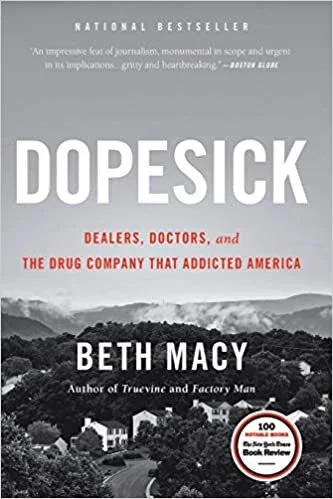
Beth Macy’s stunning book, Dopesick: Dealers, Doctors and the Drug Company That Addicted America exposes the shocking truth behind opioids and how the American epidemic unfolded in the late 1990s and early 2000s. As an author and former investigative journalist, her work in the Appalachian areas of West Virginia and Virginia reveals appalling facts and stories, beginning with the creation and rise of opioids at the hands of Purdue Pharma (insert the collective boos the TV networks plug into sports games during COVID). Macy’s book encompasses accounts from hundreds of addicts, family members, doctors, rehabilitation specialists and more as she unravels the details behind this modern-day plague and how victims and their families have struggled for years to overcome the damages caused by the company’s ignorance and greed. 

For me, the brilliance of this book comes from the humanizing of an otherwise abstract concept. Macy’s work with the surviving family members is truly heart-wrenching as they recount their experience with the attempts and failures that come along the road to recovery. In addition to the emotional appeal of the story, many share their experience not only with the past, but their futures—some not only lost family members to death and drug cults, but incurred massive debts from legal costs, medical bills and failed rehab treatments. I give the book a solid 4.5 out of 5 stars.

I’m sure many of you know of or have heard the stories about someone being addicted to heroin or opioids, some being closer to home than others. I have a cousin who has been in and out of jail for the past 15 years, struggling to stay away from heroin. As someone who has never been interested in drugs—I chalk it up to good parenting and a high school soccer coach who threatened to kick us off the team if we were caught within a “sniff” of drugs—it’s hard for me to fathom how people can get so lured into opioids and illicit drugs. However, Macy’s book was the first time I was able to comprehend a smidgen of what these addicts go through and how hard it truly is to stay away from opioids. As one coal miner from Grundy, Virginia told his doctor, “It became my God.”

Bonus: For those who are devout to the docs, Macy has a long-form story on Audible about one of the addicts and her family’s journey to find her and bring her home called Dopesick: Finding Tess. If you’re left craving more (like me), this may be a good place to start.

Guest Post by Michelle