Books make great gifts because they have whole worlds inside of them. And it's much cheaper to buy somebody a book than it is to buy them the whole world. —Neil Gaiman
Our Holiday Gift Guide is here!

Your Custom Text Here
Books make great gifts because they have whole worlds inside of them. And it's much cheaper to buy somebody a book than it is to buy them the whole world. —Neil Gaiman

Our Holiday Gift Guide is here!
History was being made in their bicycle shop and in their home, but the making was so obscured by the commonplace, I did not recognize it until many years later.—Milton Wright
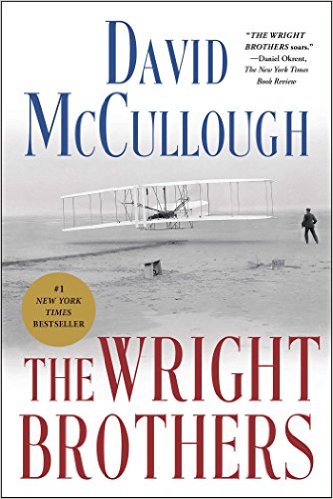
Yesterday I wrote about how the world needs more of Tracy. You know what else it needs? More Wright brothers. And while we're at it, more David McCulloughs. I've been a bit weighed down as of late, as are many, by world events, the economy, the stresses of everyday life. I've also been spending too much time at Walmart. You can't beat the prices, but that place has a tendency to suck the joy right out of a person. So it would not be a stretch to say I needed The Wright Brothers right now. And boy did they deliver.
Wilbur and Orville Wright are the epitome of the underdog. Not only did they conquer the quest for flight, but they did it with "no college education, no formal technical training,...no friends in high places, no financial backers, no government subsidies, and little money of their own, [and despite] the entirely real possibility, that at some point...they could be killed." Orville would interject here and say, "But it isn't true, to say we had no special advantages. The greatest things in our favor was growing up in a family where there was always much encouragement to intellectual curiosity."
Wilbur Wright would wholeheartedly concur with that assessment, once saying himself: "If I were giving a young man advice as to how he might succeed in life, I would say to him, pick out a good father and mother, and begin life in Ohio." And be an avid reader. Their father, a traveling preacher, was a "life-long lover of books" and "heartily championed the limitless value of reading." They may have been a family of modest means, but their book collection was far from modest. Bishop Wright wasn't a huge fan of public education, and never minded his children missing school here and there to do something he found worthy, "and certainly he ranked reading as worthy."
For years, few took notice of the miraculous events transpiring in the Wright's home and bicycle shop in Dayton, Ohio, and on the Outer Banks of North Carolina, and of those who did, most were naysayers. At the heart of this well-told story is a close knit family that endured years of mockery, scrutiny, indifference, and accusations of lying about or, at the very least, embellishing, their successes in the endeavor of flight. Buoyed by their faithful father, the lessons of their late mother, and the unwavering and indisputably essential support of their sister, Katharine, the Wright brothers never faltered nor lost faith in their abilities.
Nor did they cave to public pressure, once cancelling a scheduled flight in front of 4,000 spectators—including members of congress who had ended their session early in order to attend. As reported in the Washington Herald: "No one with a keen sense of dramatic effect could have created a better scene to demonstrate the utter immunity of the two brothers from the fumes of importunity and the intoxication of an august assemblage." One senator said upon exiting the scene, "I'm damned if I don't admire their independence. We don't mean anything to them, and there are a whole lot of reasons why we shouldn't."
Read this book. Give everyone you know this book. And if you're a fan of listening, David McCullough narrates it himself, and his grandfatherly voice will soothe your soul as much as his well-written, timely tale. As was written in a Dayton newspaper upon the Wrights receiving their overdue accolades, "[this story] points out to the ambitious young man [or woman] that he labors not in vain, that genius knows no class, no condition. The modesty of the Wright brothers is the source of a good deal of comment, but above all, there is a sermon in their life of endeavor which cannot be preached too often."
I remember something my mama
used to say on dark days:
If you can talk, you can sing.
If you can walk, you can dance.

What goes into the making of a beautiful friendship? One that weathers the years, the miles, the busyness of everyday life. Is there a magic formula? If by magic, we mean time and work, and simply always showing up, then maybe. I do know there is a blueprint for what makes a once-in-a-lifetime friend: Tracy. She takes real joy in my triumphs, suffers right along beside me in my moments of deepest sadness, and always, always make me laugh. This world needs more of her. More of her fierce loyalty, her rock solid faith, her authentic kindness. Most of all, more of her light.
We are all drawn to light, aren't we? I know I am. And when I find it within the pages of a book, I can't share it fast enough. So here it is: Home of the Brave. Light in the form of fifth grader from Sudan named Kek—a refugee who knows that while hope is hard work, it is everything; a boy who "finds sun when the the sky is dark."
Kek has seen darker moments than most of us will ever see in a lifetime. Horrors our Western minds cannot comprehend. Still, he shines light. On an aunt who's been "carved down to a sharp stone by her luckless life;" a cousin who struggles to fit into a new world he's certain does not want him; a friend in foster care; a life-weary old woman trying to keep a rundown farm afloat; and a sad, sweet, worn out cow. This boy, who weeps the first time he enters a grocery store, overcome by its "answers to prayers on every shelf," struggles to accept what to him, weeks before, were unimaginable gifts: safe shelter, a desk of his own, a pencil to write with, and a pillow to rest his head on at night. He carries with him the burden of those who may never know such gifts.
This book is a gift. Read it with your children, read it alone. Read it. This weary world needs its light. In the Author's Note at the end, Katherine Applegate reminds us that we do not need to be a refugee to feel lost. "It happens because we are human, and because life has a way of changing the rules when we aren't looking." She continues:
"Fiction, it's been said, makes immigrants of us all. But it's just as true that fiction helps us find our place in the world. A good story well-told is a compass in your pocket. A map to home. A light, always glowing, in a dark or mysterious harbor."
Or in other words, a friend like Tracy.
Everybody is a story. When I was a child, people sat around kitchen tables and told their stories. We don't do that so much anymore. Sitting around the table telling stories is not just a way of passing time. It is the way the wisdom gets passed along. The stuff that helps us to live a life worth remembering.
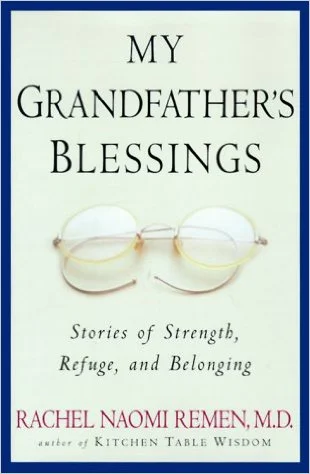
Asking a writing teacher, “What’s your favorite book?” is like asking a parent, “Who’s your favorite child?” I never can cleanly respond to my students, not without explanations or additions. There is no singular answer for me.
If asked what book I give away most, my reply is definitive: My Grandfather’s Blessings. This may mean little for some. But as one who ponders over what book to give like a grad deliberates over what college to attend, this is serious business. Giving well requires not only contemplation, but understanding. My Grandfather’s Blessings has universal appeal—it’s pure comfort on a page. It’s hard-won perspective emanating from print. And so I find myself giving it ad infinitum.
In 2001, when Rachel lost a baby not long after I’d had one of my own, I sent her a copy with tear stains on the vignette entitled Pearls of Wisdom. Author Rachel Naomi Remen illuminated how a pearl is ultimately an oyster’s response to its suffering. She explains that some suffering is too big and too deep to put behind us. Anguish becomes a part of us like a grain of sand becomes part of an oyster that opens it shell in order to breathe water. The oyster doesn’t alter its soft nature because of the pain the sand naturally causes. Instead it wraps the grain of sand in translucent layers only to produce something of great value in place of where it was most vulnerable to its pain. Remen’s apt metaphor teaches me that I can transform suffering into wisdom, which can leave me with “a deeper sense of the value of life and a greater capacity to live it.” There was little I could do to soothe my friend—I knew My Grandfather’s Blessings could provide some much needed refuge.
Years later, I gave the book to an Italian neighbor of mine. He had a spot of cancer on the bottom of his foot. Despite Bruno’s valiant efforts to bully a bit of cancer, he became terminal. I ached for him. So I put a bow around a hard copy of Remen’s short inspired stories, many of which come from her experiences as a cancer doctor of patients (some who live and some who die) and put it in his mailbox with an earnest note. Later that week, Bruno limped over to me. He told me he took the book with him to Lagoon, a nearby adventure park. While his sons experienced “what fun is,” Bruno sat under a shade tree and read the book from cover to cover. For a few serene hours, he cried and laughed on and off. He said he hadn’t felt that good in quite some time. I saw sincerity in his new eyes. Remen reminded Bruno of Proust’s truth that, “the voyage of discovery lies not in seeking new vistas but in having new eyes.”
New eyes are hard to come by. But when I read the slim chapters of this book (many are only 2 or 3 pages, amounting to a lot of stories when you close the cover on this one), I gain greater perspective. I feel full on inspiration. The subtitle Stories of Strength, Refuge, and Belonging is an accurate predictor of what you’ll automagically feel when you read My Grandfather’s Blessings. Make someone happy. Make just one someone happy this Christmas with this soulful book. And you’ll be happy too.
P.S. If you’re a fan of this read, you’ll want to acquire Remen’s Kitchen Table Wisdom—more storytelling greatness infused with unique insight and undeniable wisdom for you!
It takes a great deal of bravery to stand up to your enemies, but a great deal more to stand up to your friends. —Albus Dumbledore
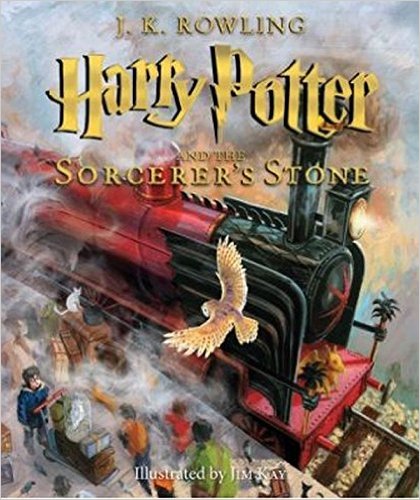
The Harry Potter Series on Audible. It's a great time to be a fan of the boy who lived. After years of waiting, Harry has finally come to Audible by way of an award-winning narrator, Jim Dale. Who doesn't love a man with a British accent? Make listening even more magical by following along with the new illustrated version of Harry Potter and the Socerer's Stone. Family reading time just got taken to a whole new level.
Book Recommendations. My brother-in-law recommended The Girl with Seven Names by Hyeonseo Lee. I read Barbara Demick's Nothing to Envy earlier this year and this looks to be the perfect follow-up read.
2015 National Book Award Winners. Fiction: Fortune Smiles: Stories by Adam Johnson. Nonfiction: Between the World and Me by Ta-Nehisi Coates. Poetry: Voyage of the Sable Venus by Tobin Coste Lewis. Young People's Literature: Challenger Deep by Neal Shusterman. For more about these and the runners-up, read here.
That promised review of The Wright Brothers.
The book that Tracy gives most.
Get your Christmas on because our Holiday Gift Guide is live on Friday!
Clearly one must read every good book at least once every ten years. —C.S. Lewis
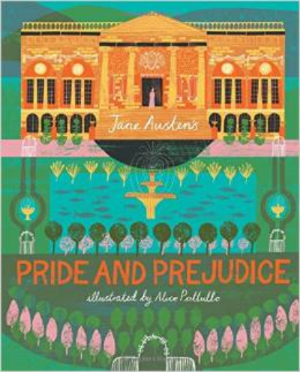
We're letting our Holiday Gift Guide hijack Throwback Thursday this week so you can be the hero of those on your list with a penchant for the classics. (Or, of course, give you ideas for your own Santa list.) We are in love with the Classics Reimagined Series, featuring modern artists' visual interpretations of age-old favorites. Since we, like Dodie Smith, wish we "lived in a Jane Austen novel," we're especially smitten with Alice Patullo's interpretation of Pride and Prejudice just published last month.
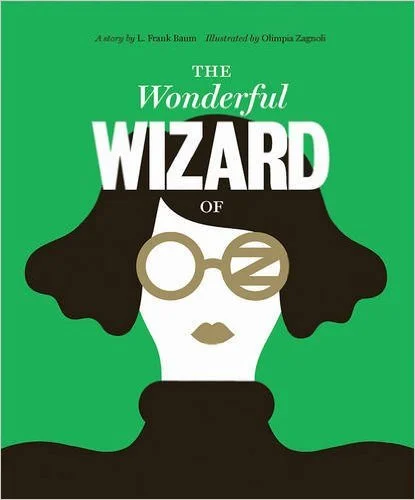
Dorothy gets a modern makeover thanks to Olimpia Zagnoli. The Wonderful Wizard of Oz just got more wonderful.
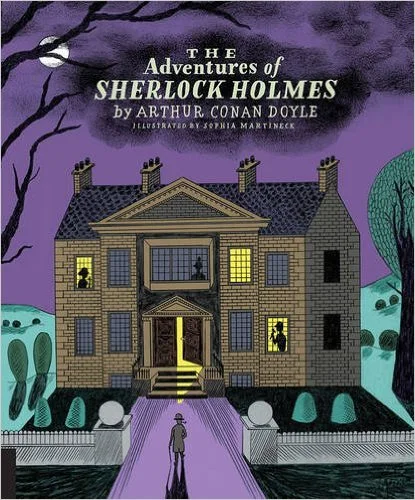
221B Baker St. never looked so good...or should we say eerie. Award winning artist, Sophia Martineck makes Mr. Sherlock Holmes more mysterious than ever. Pardon us as we let our alliteration run amok.
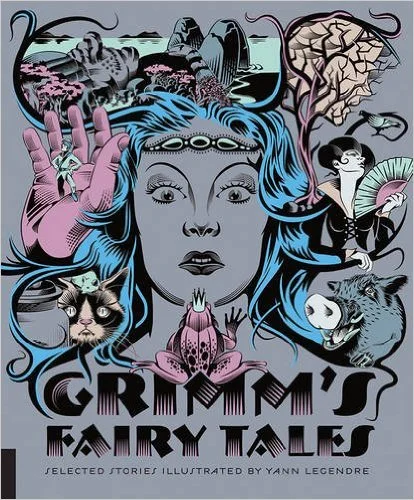
French artist, Yann Legendre really knows how to bring out the grim in Grimm's Fairy Tales. As a side note, Yann's last name is pretty legen...wait for it..dary.
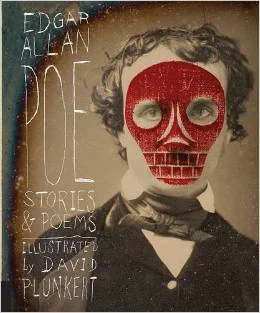
Judging a book by its cover, David Plunkert's interpretation of Edgar Allan Poe looks to be the stuff nightmares are made of. We're talking creepy with a capital C. Which is exactly what fans of good ol' Edgar crave.
Heaven goes by favor. If it went by merit, you would stay out and your dog would go in. —Mark Twain
We're launching our Holiday Gift Guide posts with books for those charmed by the chien. And really, who isn't? Put your hand down, Tracy.
Tray isn't what I'd call a dog lover—more like a dog tolerate-r; something about all that fur stops her well short of love. She is, however, easily charmed by a lovely read, and these books are guaranteed to leave even a dog tolerate-r enchanted.

If you have yet to meet Maira Kalman's books, prepare to fall in love—with her illustrations as much as her prose. Maira Kalman is the quirky, delightful aunt everyone wants to be seated by at the Thanksgiving table. She is also the author of one of my favorite children's books: Ooh-la-la (Max in Love). She deserves a post of her own, but for now, here's a snippet from Beloved Dog:
There are Trees.
Glorious and Consoling.
Changing with the seasons.
Reminders that all things
Change. And change Again.
There are Flowers, Birds,
Babies, Buildings.
I Love All of these.
But Above All, I Am Besotted
by DOGS.

My brother, who was a beautiful poet himself, introduced me to Mary Oliver years ago and I've been a fan ever since. Her poems are lovely—the kind you don't need a study guide to understand. And now that I know she loves dogs as much as I do, she's officially joined the list of people I'm best friends with in my mind. Here's one of my favorites from Dog Songs:
HOW IT IS WITH US, AND HOW IT IS WITH THEM
We become religious,
then we turn from it,
then we are in need and maybe we turn back,
We turn to making money,
then we turn to the moral life,
then we think about money again.
We meet wonderful people, but lose them
in our busyness.
We're, as the saying goes, all over the place.
Steadfastness, it seems,
is more about dogs than about us.
One of the reasons we love them so much.

Anna Quindlen's Good Dog. Stay. is an oldie, but so good it warrants mentioning here. I'm thinking the whole kindred dog-loving thing may give me a leg up in the imaginary friendship Tracy and I have with her. Not that it's a competition... This book is especially comforting to anyone who has recently lost a beloved dog. Here's a little of what she says about her own sweet dog, Beau:
“...there came a time when a scrap thrown in his direction usually bounced unseen off his head. Yet put a pork roast in the oven, and the guy still breathed as audibly as an obscene caller. The eyes and ears may have gone, but the nose was eternal. And the tail. The tail still wagged, albeit at half-staff. When it stops, I thought more than once, then we’ll know.”
It is only with the heart that one can see rightly; what is essential is invisible to the eye.

I’m a fan of the intangible. And I’m rarely rocked by the unseen. In fact, faith feels comfortable to me, like the skin I’m in. Sometimes I think with all of our modern advancements, we miss out on the simple stuff that helps us feel. That helps us remember. So I make it a point to wrap myself up in nostalgia often. Books are a means to a nostalgic end. Years ago, I lapped up I Capture the Castle and felt myself back in England again. I made sure Rachel read a copy, so she was there with me too. Seemed like old times. When Rae gave me 84, Charring Cross Road that warm, shimmering feeling returned. Jane Austen is guaranteed comfort.
Few books feel more nostalgic to me than The Little Prince. I can no longer remember when my mom introduced me to the curly toe-headed boy who hails from another planet and never answers direct questions. A boy who captured even my young heart. Aptly called a prince, he reminds me that being an adult may be a bit over-rated: “Grown-ups never understand anything by themselves, and it is tiresome for children to be always and forever explaining things to them.” It seems reasonable then that the boy teaches the novella’s narrator, a pilot who has crashed his plane in the Sahara Desert with only a week’s supply to survive, to hear laughter in the stars. The pilot and I remember our inner child. We reminisce about the wonder of childhood and long to return—if only to worry less about life’s utilitarian concerns and focus more on finding harmony. To watch more sunsets.
My favorite lesson from the philosophical fairy tale is about love. From the very beginning, the pilot’s drawings of a boa constrictor digesting an elephant—from the inside out—hints that everyone conceals within themselves a treasure. Every person possesses a secret goodness that can only be discovered with the heart. The fox, like a hundred thousand other foxes, recognizes that if the prince tames him, they will have a unique relationship. (I imagine Rachel and I have tamed one another.) It is the fox who perceptively says, “And now here is my secret, a very simple secret: It is only with the heart that one can see rightly; what is essential is invisible to the eye.”
That is the secret isn’t it—the one that children seem to understand and adults often forget. So we need reminders that our hearts should be in charge. That is why I come back to this gem often. (The pictures speak to me too.) It’s small like the prince’s planet complete with 3 volcanoes, some plants, and a rose with 4 thorns. This charmer is well worth 60 minutes of your time. There are ample reasons this book has sold over 140 million copies worldwide. It will melt your heart—it does mine every time.
More nostalgia coming our way in March of 2016:
Quisque iaculis facilisis lacinia. Mauris euismod pellentesque tellus sit amet mollis.