Not Your Typical Walk in the Park

“Trying to work out where it all began, where it all started going wrong. And I suppose the real answer is it started years before you could have ever imagined it did.”
It’s a book and it’s based in London. Dare I give you another reason why I picked up this book?

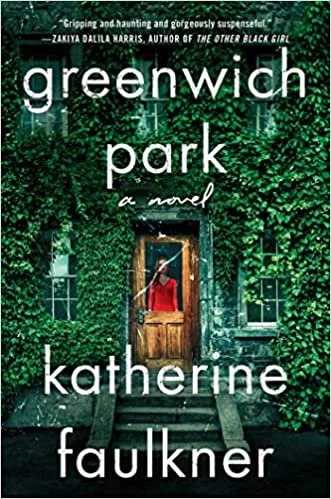
Katherine Faulkner’s latest novel details the story of a beautiful family home in Greenwich Park, London, and all the family secrets in it. We’re given insights into three characters’ lives: Helen, Serena, and Katie. Helen is the oldest and only daughter in the Haverstock fam. Known for their exquisite architecture company, Helen moves into the family home with her husband, Daniel, as they await the birth of their first son. Serena is married to Rory, the oldest son and middle child of the Haverstock clan. They also await the birth of a baby, a girl. Katie is a journalist; she’s the girlfriend of Charlie, the youngest of the Haverstocks. Don’t worry, they aren’t expecting a child. That would be too cute.

While attending antenatal classes (or birth classes as we Pats call them), Helen meets Rachel, a young and soon-to-be solo momma. The two pregos develop a “friendship”; Rachel keeps Helen company during her time off work. Combine the friendship with the house remodel, and you have a story that isn’t as simple and family-friendly as one would imagine from the looks of the things in Greenwich Park.

Props to Faulkner for providing unique twists on a not-so-average family tale. Who doesn’t love unexpected turns? My only complaint is the author allows you to figure out the storyline too quickly, in lieu of the anticipation we readers love and crave. The twist at the end, however, is delicious. Four out of five stars for this London tale that will put your dysfunctional family to shame.
Posted by Michelle

Starry, Starry Night

“I believe in the joy of reading and having lots of books around you that you want to read, have read and may never read.”  Marilyn Rolapp Brinton

I’m not sure how many followers we have here at two at twenty-seven. Those are details Rae tracks. (She has a lovely eye for detail.) I do know that we lost one of our favorite readers this month. Marilyn Brinton, my sister’s mother-in-law and my dear friend and fellow book lover, passed away. Maybe she’s paid a quick visit to The Midnight Library? Although she wouldn’t need to try on other lives since she knew, better than most, how to live wholly—a life brimming with laugher and love and of course, plenty of good reads. She and I exchanged the best books. I was so excited to give her The Marriage Portrait for Christmas. I’m sure Maggie O’Farrell grabbed Marilyn’s heart like she did mine. When I heard the news of her passing, I cried. The world felt instantly more dim. What an irresistible light. I couldn’t help but think of Shakespeare’s advice, “And when [she] shall die, take [her] and cut [her] out in little stars, and [she] will make the face of heaven so fine, that all the world will be in love with night, and pay no worship to the garish sun.”

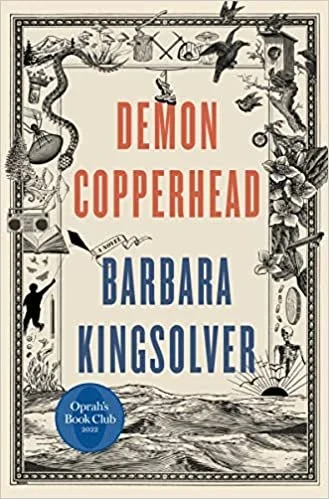
I’m mourning the fact that I can no longer share glittering pages with Marilyn. I’d definitely give her my latest, Demon Copperhead. She was a fan of the classics. I wish we could discuss Kingsolver’s undeniable genius in her close retelling of David Copperfield here. I know we’d agree, “It’s hard to think of another living novelist who could take a stab at Dickens and rise above the level of catastrophe.” Named one of the “10 Best Books of 2022” by The Post and The Times, it’s not for everyone. It’s a rough-and-tumble read. The central character, Damon Fields, is born to a teenage girl who prepares for motherhood with amphetamines and Vicodan. Oh, and gin, don’t hold the gin. Damon, nicknamed Demon, is a lot like a meteoroid—when he enters rural south Virginia’s atmosphere at a high speed, his childhood burns up quickly, and he hits the ground hard, not running. Because Marilyn believed in the importance of staying curious, she would look beyond profuse swearing because she knows that profanity isn’t simply a sign of language poverty or lack of intelligence. Surely, she would find deep relevance in the book’s underlying issues that are in need of a monster-sized vehicle for social change: big pharma and the opioid crisis, poverty and rural dispossession, along with the ineffectiveness of child-welfare agencies and our sometimes backward public education system (especially in the backwoods). She would see the best in Demon. I know she would. If possible, she’d pull him into her magnetic orbit and, without preaching, tell him not to save his juice—use it up, Demon. Use it all up. Give it to each and all we meet. Freely. And beautifully.

P.S. If you’re a sensitive reader, check out this review to see if Demon Copperhead is right for you.

Posted by Tracy

Murder With a Side of British Coterie

“After a certain age, you can pretty much do whatever takes your fancy. No one tells you off, except for your doctors and your children.”

Aging is not at the top of my To-Do list. But Richard Osman may have me thinking a little revision is in order. When a murder occurs in the town of Fairhaven, there’s not a better group of sleuths than The Thursday Murder Club. Comprised of four members from the retirement village of Cooper’s Chase, the team sets aside the club’s traditional activities of solving old murder cases from the 70s and 80s to dive head-first into what happened to Tony Curran—the man who built the retirement village himself. The only thing standing in their way of cracking the cold case? If you guessed The Fairview Police Department, you need to join Thursday’s club!

Retirees Elizabeth, Ibrahim, Ron, and Joyce are a lovely team, all with different strengths, weaknesses, and cheeky attitudes. You’ll love the bonds of friendship formed with one other and the police constables. I listened to this book and found myself breaking a smile multiple times at these sassy septuagenarians. (Don’t think for one minute I didn’t laugh out loud.) When I grow up, I want to be like these golden agers!  

Four out of five stars for our fearless friends. The Guardian hailed TMC as the “fastest-selling adult crime debut” in recorded history. Here’s the good news: Osman’s just getting started. He may well be building a crime caper empire. Sequels to TMC include The Man Who Died Twice and The Bullet That Missed. We’re giving you a heads-up to get caught up with the 60+ murder squad by September 2023—that’s when a fourth book shows up with a new crime scene. So grab a few minutes, cozy cover, and your curiosity to watch the geriatrics crack open a few cold cases. Regardless of your age, Osman will take your fancy.

P.S. It shouldn’t surprise The Thursday Murder Club is soon to be a major motion picture, thanks to Steven Spielberg.

Posted by Michelle

Somethin’ to Holla About

“I shall be miserable if I have not an excellent library.”  —Jane Austen, Pride and Prejudice

Hear! Hear! Jane. Not that I measure Christmas success by the quality of books I get—that might be considered borderline obsessive—but I’m so pleased with the library additions I received this snowy December. Wanna hear about a few? Let’s start with the darling, the aficionado, the two at twenty-seven brainchild, my girl Rae’s perfectly wrapped hardcover under the tree. She sent me British-born Jess Kidd’s latest, The Night Ship. We discovered Kidd together, the last time we were in Londontown. I’ve since seen The Night Ship on Barnes & Noble’s Top Ten Best Fiction of 2022; I wasn’t surprised, are you? Rae picks winners like Renior picked flowers. Love her.

My longtime friend, K.P., sent me a novel I’m currently listening to on audible and absolutely lovin’. Can’t wait to blog about Barbara Kingsolver’s Demon Copperhead. I’ve got an Appalachian Elegy in my ears and it’s giving my imagination somethin’ to holla about. Melly gave me a fat B&N gift card, so I bought myself Jenna’s recommend: The Cloisters along with the book I gave Rae: I Must Betray You. Something tells me we’ve got some star-studded reviews headed your way. So be sure to look ahead!

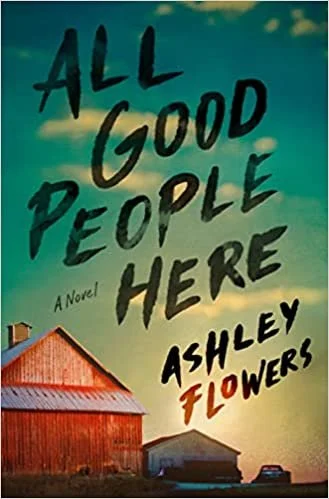
In the meantime, I finished one of “The Best Mysteries of 2022.” I chose a mystery on purpose. (Not sure how any book could adequately follow The Marriage Portrait, so a different genre seemed like a good idea.) Maybe Sharee’s heard of Ashley Flowers, the “Crime Junkie” podcast host. Her debut novel All Good People Here was entertaining. The Junkie’s protagonist is a reporter named Margot Davies, who can’t shake the need to solve a cold case involving her childhood friend, January Jacobs. (January’s character was obviously inspired by JonBenet Ramsey.) There were plots twists throughout. Flowers found ways to keep things interesting, but there were moments of predictability for me. I can’t say that for the book’s ending. Unlike some reviewers, I thought the ending worked. I totally agree with this thought: “In a genre overrun by gratuitous violence against female characters, Flowers has applied everything she has learned from her own investigations to create a thriller that doesn’t shy away from the truth about violent crimes but doesn’t celebrate or forgive them either.” That being said, if you’re itchin’ for a thriller, I’d go with The Maid ahead of All Good People Here.

Posted by Tracy

You Had Me At Hamnet

“That’s my last duchess painted on the wall,
Looking as if she were alive”

I don’t know about you, but I’m keeping track of Rae’s imaginary BFF’s. That girl’s got taste. I too have some best friends in my head. Lately, Maggie O’Farrell is my bestest and brightest pretend friend. To quote Rae, “If we lived next door to each other, I just know we’d get along swimmingly.” Maggie may suggest otherwise, but that’s the thing about pretend friends—my dream world, my dream details. If you haven’t heard, Mags has won a slug of awards for nearly a dozen books. (We’re talkin’ critical acclaim stuff.) She hails from Ireland. If you guessed redhead, you guessed right. Like King George VI, she suffered from a pronounced stammer when she was young but made her way to Cambridge just the same. Maggie is a literary queen. Frankly, she had me at Hamnet. The fact that she followed her award-winner about Shakespeare’s son with a novel equally compelling rocks my bookish socks clean off. Which lucky historical figure caught Maggie’s eye this go around? Lucrezia de’Medici.

If you haven’t heard of Lucrezia don’t worry, you’re not alone. History barely snagged a glimpse of the 15-year-old girl who married the Duke of Ferrara. Mags not only pulls back the curtain to reveal the inner world of a 16th century Italian noblewoman, she quietly exposes the unfairness of gender and social mores at the time. Lucrezia, a girl predisposed to nature and art, is relegated to confinement—she commutes from one of the Duke’s “prisons” to another. Of course, the Jane Austen lover in me is enchanted by O’Farrell. (Jane has always been a number 1 pretend friend.) She too masters the meaningful layers beneath the surface story.

If you’re not into literary layers, you’re still in luck. My BFF’s got you covered. The Marriage Portrait begins with the Duke taking his now 16-year-old wife to a dank “hunting lodge.” Flanked by a dense forest, they sup alone at a long table in a darkened hall. We read, “This is the reason for their sudden journey to such a wild and lonely place. He has brought her here, to this stone fortress, to murder her.” Mags creates intrigue on page one. I couldn’t turn the rest of her pages fast enough. (Actually, I listened to Genevieve—the voice of Harry Potter’s Pansy Parkinson—on audible and loved it; my BFIMH is on there too!) What a star you are, Maggie O’Farrell. Keep ‘em comin’, I pray you!

P.S. Hats off to fab poet Robert Browning who immortalized Lucrezia in his famous poem “My Last Duchess.”

One more P.S. Rae and I snatched this Book of the Year finalist long before Reese put her sticker on it. Why do I feel the need to put that in print?

Posted by Tracy

True Crime Vibes

“I’ve already learned my lesson here: when you catch someone lying about a murdered girl, you go ask them why.”

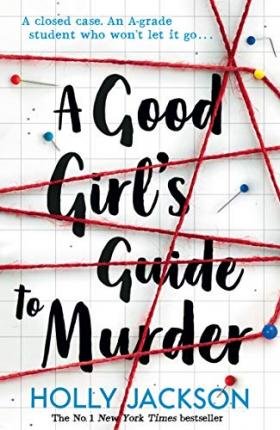
An excellent true crime seems to get all of us here at two@twenty-seven, especially Sharee. You’ll recall she’s a devout follower of Dateline. She records the episodes she misses! It’s in the genes apparently because I felt the itch for a little lawlessness. And I was looking for an easy read. One that didn’t require a lot of brain power but kept me interested. A while back, my friend mentioned that she loved Holly Jackson’s A Good Girl’s Guide to Murder for its true crime vibes. So I picked it up because I hadn’t read a YA novel in a while.

Set in Fairview, Connecticut (a fictional town in Fairfield County where Tray and Sharee grew up!), Pippa Fitz-Amobi found the perfect project for her senior capstone project—uncover what happened to the murdered Andie Bell. The only problem? The police closed the case 5 years ago when Andie’s boyfriend, Sal Singh, was found dead in the woods with a confession on hand. Regardless of what the police say, something just doesn’t sit right with Pip. She decides to take matters into her own hands. An intricate web of lies, deceit, and shady dealings lead Pip down a dangerous path to discover what actually happened to Andie that fateful night.

Like many YA novels, this feels more adult as it mentions suicide, rape, sex, and drugs. I’m giving it a solid 4 out of 5 stars. Oh, and despite being a paperback purist, I listened to this thrilla in 3 days. Look at me go!

*Bonus points to you if you can find the UK version and get your hands on it–the author adapted the original UK version to a US version.

Posted by Michelle

Home of the Not So Brave

“Story, as it turns out, was crucial to our evolution—more so than opposable thumbs. Opposable thumbs let us hang on; story told us what to hang on to.”  Lisa Cron

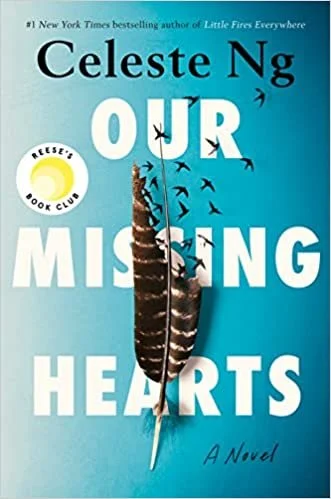
Opposable thumbs got me into trouble today. The right one in particular—it aided and abetted my primary hand in hoisting bacon and date dip on toasted baguette into my stuffed gut. Everyone should have been so lucky. But that’s not what I’m hangin’ onto. I’m locked on Celeste Ng’s latest story: Our Missing Hearts. Unlike the bacon and dates, this book does not satiate—it isn’t meant to make an American audience feel comfortable. Some are calling Our Missing Hearts dystopian. Others disagree with that label. If dystopia constitutes, “An imaginary place in which everything is as bad as possible,” it’s safe to say, OMH is not feelin’ good in the neighborhood.  

America has a new standard for keeping time: before and after “The Crisis.” Economically devastating and chaotic, the crisis eventually ends with the passing of PACT—the Preserving American Culture and Traditions Act—which essentially marginalizes persons of Asian origin. Fear and Suspicion replace freedom and speech in the home of the not-so-brave. Could things be worse? Books aren’t being burned; they’re being pulped instead. And children of vocal parents who don’t meet the status quo are being taken from their homes. When Bird Gardner’s Chinese mom preemptively leaves her boy and husband to spare her son’s “replacement” in a foster home because of some poems she wrote in grad school (that are being subversively interpreted as radical), their lives change forever.  How is Bird supposed to make sense of his surroundings? Fortunately, his twelve-year-old heart hasn’t become embittered, even in the face of abandonment. Thank you, Bird. Because you set out to find your missing mother, I was reminded of the beautiful and horrifying weight of words. Stories are crucial to our evolution. And no one can stop the strong from sharing powerful stories.

Posted by Tracy